
What is an energy management system (EMS), how does it work, and what benefits does it offer businesses? An EMS provides the technical foundation for efficiently tracking, controlling, and economically optimizing energy flows within a company. As complexity increases due to photovoltaic systems, battery storage, charging infrastructure, and volatile electricity prices, an EMS is becoming an essential tool for companies to reduce costs and leverage flexibility for economic gain.
Table of contents
ToggleDefinition of terms
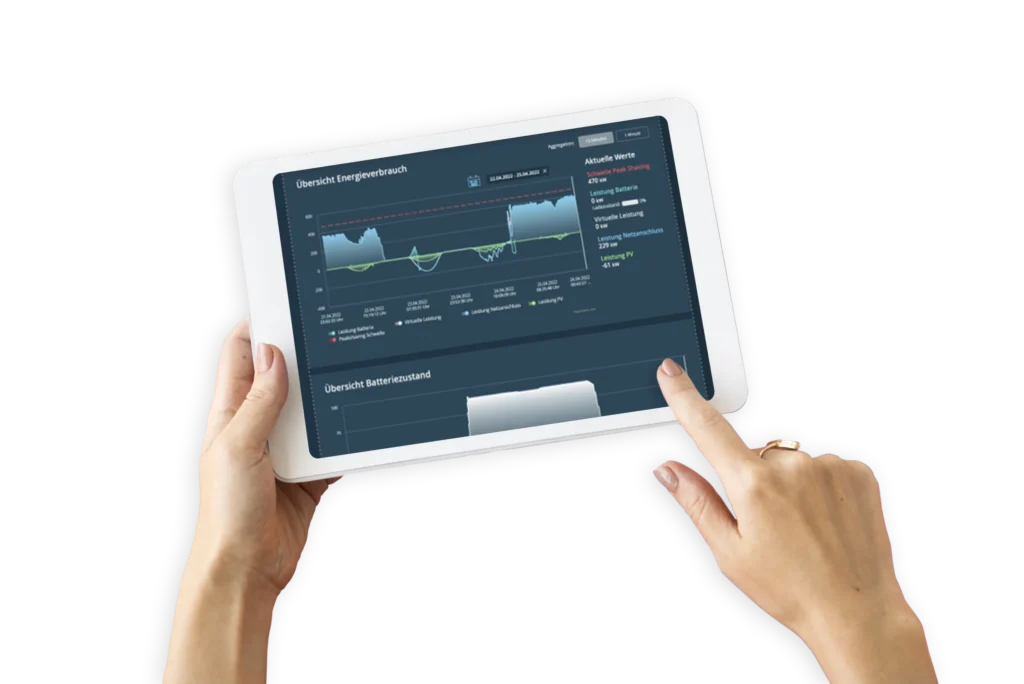
An energy management system records, analyzes, and controls energy generation, consumption, and storage in real time—in practice, this usually involves a combination of hardware, software, and a central platform. The goal is to coordinate energy flows within a company in such a way that economic, technical, and regulatory requirements are met as effectively as possible.
Functions of an Energy Management System
The key functions of an EMS include:
- Real-time collection of generation and consumption data
- Forecasting Load Curves and Generation Profiles
- automated control of systems such as battery storage systems or charging stations
- Prioritizing Multiple Use Cases Based on Economic Benefit
- Documentation and Reporting for Operations
How It Works
An EMS continuously processes data from various sources, such as meters, inverters, weather forecasts, and market price signals. Based on this data, it makes automated control decisions, such as when to charge or discharge a battery storage system or release energy for sale. The control logic takes into account both operational priorities and external signals such as electricity prices or grid requirements.
Multi-Use-Case Operation and Use Cases
A key economic advantage of modern EMS lies in what is known as “multi-use-case operation,” in which multiple use cases are handled in parallel, such as:
- Reducing Load Peaks Through Peak Shaving
- Increase in self-consumption from PV or wind power systems
- Avoiding Expensive Grid Fees Through Non-Standard Grid Usage
- Marketing of Available Storage Capacity in Short-Term Electricity Markets
The system determines, based on the situation, which use case currently offers the greatest economic benefit.
Technical Requirements
The following are generally required to operate an EMS:
- Digital measurement technology for data acquisition
- Interfaces to systems such as storage units, inverters, or charging infrastructure
- a stable communication link for real-time control
- Clear prioritization rules for competing use cases
Relevance for companies
An EMS is particularly relevant for companies with:
- self-generated electricity from solar or wind power
- Battery storage or charging infrastructure
- high or fluctuating electricity consumption
- Interest in generating additional revenue through flexibility trading
Relationship with energy storage and flexibility
Energy storage systems only realize their economic potential when integrated with a high-performance EMS, as this system automates charging and discharging decisions and makes them in an economically optimal manner. In conjunction with concepts such as Demand Side Management (DSM) and (grid-optimized storage control), the EMS becomes the technical control center for leveraging flexibility.
Distinction from related terms
Not to be confused with:
- Energy Monitoring & KPIs (EnPI): Simply collecting and analyzing energy data without automated control
- (Decentralized Grid Control): a supplementary, automated control layer at the grid level that extends the logic of an EMS
- Demand-Side Management (DSM): an overarching concept for demand management that an EMS implements technically
- (Grid-Optimized Storage Control): a specific EMS application focused on grid stability rather than economic efficiency
Summary
An energy management system provides the technical foundation for efficiently and automatically controlling energy generation, consumption, and storage in businesses. By simultaneously handling multiple use cases in multi-use-case mode, costs can be reduced and additional revenue generated. As complexity increases due to renewable generation, storage, and volatile electricity prices, an EMS is increasingly becoming a key prerequisite for economical and future-proof energy use in companies.