
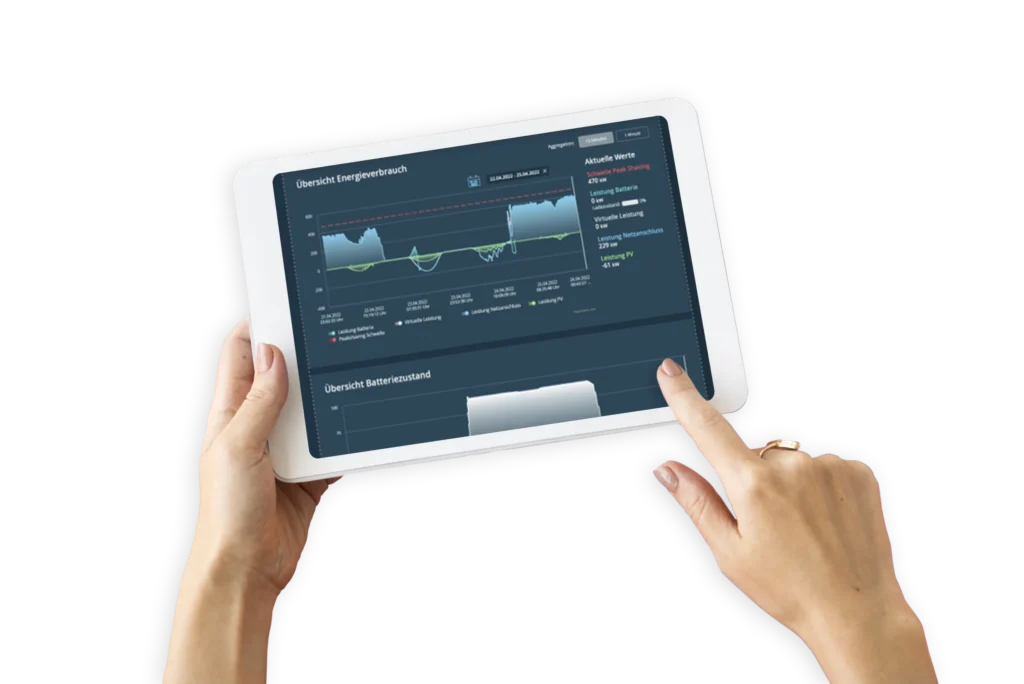

Dynamic charging management refers to the real-time, demand-based distribution of available charging power across multiple charging points within a charging infrastructure. Unlike static charging management, in which a fixed power level is assigned to each charging point, dynamic charging management continuously adjusts the distribution to actual demand and available grid connection capacity. For operators of charging parks, fleet locations, and public charging infrastructure, dynamic charging management is a key component for making optimal use of the grid connection without overloading it.
Table of contents
ToggleDefinition of terms
Dynamic charging management, also known as dynamic load management, continuously monitors a site’s current total electricity consumption and constantly adjusts the charging power of the connected charging points to the available grid connection capacity —supplemented, if necessary, by other systems such as PV generation or building loads. The goal is to use the available grid connection capacity as efficiently as possible while preventing the grid connection point from becoming overloaded.
Static vs. Dynamic Charge Management
Static load management relies on fixed maximum values that are defined in advance for a charging park or a group of charging points. The available power is distributed evenly among the connected vehicles, regardless of the actual demand at any given moment. This approach is technically straightforward and ensures that grid capacity is not exceeded—however, unused capacity often goes to waste because there is no adjustment based on the current situation.
Dynamic load management, on the other hand, continuously monitors actual demand and flexibly allocates available power accordingly. Modern systems are increasingly taking a proactive rather than purely reactive approach by forecasting load behavior and generation.
- Static charging management: fixed, even distribution of charging power across all charging points, regardless of actual demand
- Dynamic Load Management: Continuous adjustment of load distribution based on demand, downtime, and available grid or residual load
How It Works
- Continuous monitoring of total electricity consumption at the utility connection point
- Determination of available residual capacity (residual load), taking into account the facility’s own generation—such as PV—where applicable
- Allocation of charging power according to a defined allocation logic, such as the fair-share principle or other prioritization approaches
- Continuous adjustment in response to changes in fuel consumption or the number of vehicles
Technical Requirements
- Real-time measurement at the utility connection point
- Communication-enabled charging points, e.g., via OCPP
- central control logic or an energy management system
Relevance for Charging Infrastructure Operators (CPOs)
For operators of public charging stations, fleet locations, and logistics depots, dynamic charging management is a key prerequisite for economically scalable charging infrastructure: It helps maximize the use of existing grid connection capacity and operate it efficiently—without the need for costly grid expansion. An additional pre-charge storage system can further expand the site’s capacity and reduce the load on the grid connection even more.
Relationship to Energy Management Systems
In practice, an energy management system handles the technical implementation of dynamic charging management by analyzing consumption data in real time and automatically controlling the charging power. When combined with a pre-charge storage system, the available grid connection capacity can be further expanded virtually.
Distinction from related terms
Dynamic charging management should not be confused with:
- Fair-share principle: a possible allocation logic within dynamic load management, not the overarching control concept itself
- Peak Shaving for Charging Stations: A special case for the targeted reduction of peak loads; not the same as ongoing power distribution
- (Grid-Optimized Storage Control): a supplementary measure focused on grid stability rather than capacity allocation
- Atypical grid usage: a pricing mechanism that benefits from a stable, predictable load curve, such as that generated by dynamic load management
Summary
Dynamic charging management is the foundation for the cost-effective operation of modern charging infrastructure. By distributing available power to all active charging points in real time, the existing grid connection can be utilized to its fullest without overloading it or requiring costly upgrades. When combined with an energy management system, this creates a scalable, future-proof solution for charging parks, fleets, and logistics sites.
Note: This article is intended for general informational purposes only and is not a substitute for individual legal, technical, or financial advice.