
Optimizing Charging Efficiency: okean at EWE Go & EWE Go Hochtief
Given the rapid increase in electromobility, ensuring a stable, efficient charging infrastructure is becoming a central task. Hyperchargers place an enormous load on the power grid, and without intelligent energy management, charging stations can lead to inefficiencies, high grid costs, and grid overloads. For this reason, we at be.storaged, together with EWE Go and EWE Go Hochtief, have implemented a state-of-the-art energy management solution that optimizes energy distribution, reduces costs, and prepares for future challenges in the energy sector.
The Challenge: Handling High Demand and Network Restrictions
EWE Go operates numerous high-performance charging stations equipped with hyperchargers. However, during peak times, the available grid connection is often insufficient to provide the total required charging power. This imbalance not only poses the risk of network overload, but also limits the charging speed and leads to efficiency losses.
In addition, EWE Go faced the challenge of integrating real-time signals from grid operators. These signals are crucial for optimizing charging behavior, especially in areas where grid stability is an issue. Without an intelligent management system, adapting to these signals and ensuring smooth operation became increasingly difficult.
At the same time, EWE Go Hochtief, a joint venture between EWE Go GmbH and HOCHTIEF AG, was awarded the contract for over 100 charging stations as part of the Deutschlandnetz, a public charging infrastructure initiative of the Federal Ministry for Digital and Transport (BMDV). These locations, which are scheduled to go into operation in 2025 and 2026, will provide high-performance charging stations with a capacity of 800 kW to 3.2 MW per location throughout Germany. As with EWE Go, be.storaged has entered into a contract to provide our load management system for Deutschlandnetz locations.
The Solution: Dynamic Load Management and Peak Load Coverage
To address these challenges, we have introduced our Energy Management System (EMS) okean, which offers several key benefits:
Dynamic Load Management
okean intelligently distributes the available grid power to multiple charging points in real time to prevent congestion and ensure efficient energy use.
Peak Shaving
By strategically managing power consumption, okean reduces high demand spikes in the grid and lowers electricity costs by minimizing peak loads, which typically incur higher tariffs.
Grid Signal Processing
okean responds directly to signals from the grid operator and optimizes charging operations based on real-time grid conditions.
Atypical Use of the Grid
Thanks to optimized charging behavior, EWE Go benefits from lower grid fees, making the entire charging infrastructure more cost-efficient.
One of the main advantages of this deployment was the low hardware requirements. The installation space in substations is limited and expensive, making it difficult to implement traditional energy management solutions. To solve this problem, okean was implemented on a small IoT gateway, eliminating the need for bulky hardware while maintaining full system functionality.
The Results: A Major Step Towards Smart Charging
In 2024, we successfully enabled atypical grid use at a pilot site, optimized power consumption, and achieved a significant reduction in grid fees, without battery storage. This milestone demonstrates how intelligent software solutions can improve electric vehicle charging infrastructure, making it more flexible, efficient, and cost-effective.
With real-time monitoring, load balancing, and predictive control, okean ensures that EWE Go’s and EWE Go Hochtief’s charging networks operate with maximum efficiency while being adaptable to future energy innovations.
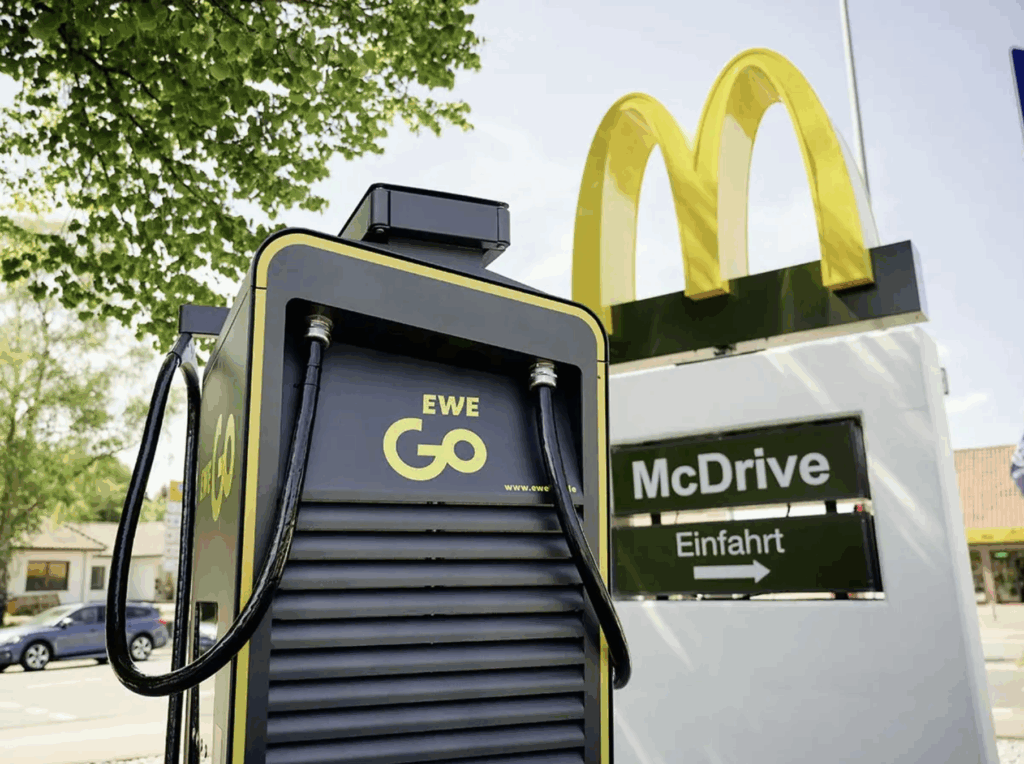
EWE Go Hochtief is preparing to build more than 100 charging stations in the Deutschlandnetz. We are proud to support the company’s load management and promote the nationwide expansion of intelligent electric vehicle charging. Through EWE Go’s partnerships with major brands such as McDonald’s and Lidl, our technology is also integrated into their charging infrastructure, ensuring efficient and scalable energy management. With the planned expansions, this partnership is an important step towards a cost-effective and sustainable future for electromobility.