
Multi-Use-Case Hamburger Hochbahn
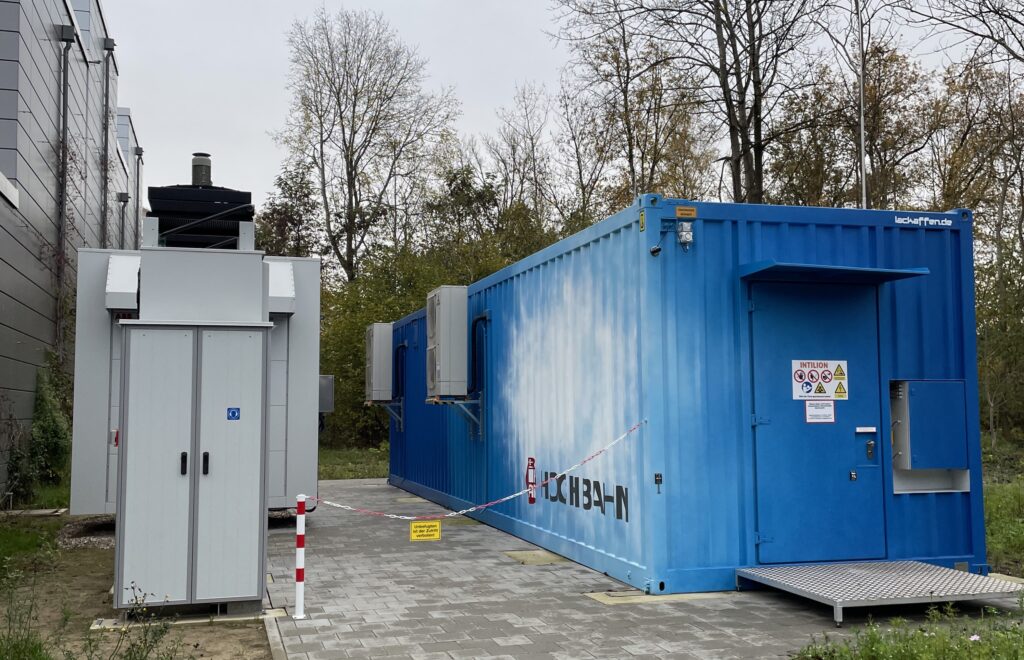
The innovative project of Hamburger HOCHBAHN includes the construction of charging stations for 240 buses and the use of the knowledge and experience gained for a research project on data analysis. be.storaged supports Hamburger HOCHBAHN in this project by having Ramy Solimann, an engineer at Hamburger HOCHBAHN, take over the entire project planning. As part of this project, a battery storage system will be installed to support the charging infrastructure. The storage system, which is housed in a 45-inch container, has a capacity of 4 MWh lithium-ion (LFP) and will be connected to a 4 MVA converter and a 4 MVA transformer. The company’s own 20 kV grid can be used for the transformer. The project started in October 2023, and completion is scheduled for September 2024. In the spring of 2024, all civil engineering measures, including pipe laying, the construction of the ring earth electrode, and the foundation, will be implemented to enable the delivery of the storage system in mid-May.
Areas of application and the effectiveness of charging infrastructure support
The battery storage is planned for the largest electric bus depot, which will connect 240 buses to a 150 kW charger from September. The main purpose of the battery storage is to optimize the unusual grid usage and to market flexibilities outside of peak load times. The next step is to equip the bus station with a PV system to generate renewable energies. These can then be used by the battery storage system to optimize self-consumption. The project will provide HOCHBAHN with valuable experience that can later be transferred to other locations. The use of the battery storage system will achieve improved overall flexibility, which will result in reduced grid fees and additional income from the marketing of flexibilities. In addition, further battery storage systems at other depots can compensate for grid capacities, which reduces the need for grid expansion.
Precautions and integration of the storage system
HOCHBAHN has its own 20 kV medium-voltage grid, which means that the storage system can be connected directly. However, an inverter and a transformer are also required. The switchgear for this concept has already been pre-installed, as the planning of a 110 kV substation with a hydrogen generation plant began a few years ago. The focus is now on battery-electric buses, which benefit from this infrastructure and the available space. The carports and the charging technology can be supplied directly from the 20 kV level, and the preparations for the construction are therefore limited to a core drilling in the substation and the coordination of the trades on the site, as the project is being implemented during operating hours. During peak times, around 200 buses pass through the depot within 1.5 hours. The coordination of the project implementation must take this cycle into account, as bus operations always have top priority. A challenge will therefore be the planning of crane work, which requires the temporary closure of an important passage.
Goals and economic expectations of Hamburger HOCHBAHN
HOCHBAHN is working together with Stromnetz Hamburg, Helmut-Schmidt-Universität, and the Technical University of Hamburg on the research project “KoLa” (Coordination function of the distribution network and load management for electrified passenger transport.)
Ramy Solimann commented on this as follows: “Within this framework, further possibilities in the context of grid congestion management are being researched and implemented in practice. The aim of the project is to gather initial experience with the construction and, in particular, the operation of a battery storage system and thus gain important insights for possible follow-up projects at other depots.” Of particular interest are data such as the reaction times in the event of atypical grid usage, the revenues from the marketing of flexibilities, the power flows – and gradients, as well as the battery charge levels and the development of the State of Health (SOH).
HOCHBAHN expects the system to pay for itself within 10 years. A decisive factor for this expectation is the atypical grid usage in conjunction with the marketing of flexibilities. The durability and required repairs also play a role in the economic focus “In general, it can be said that flexibility in the power grid of the future will play an increasingly important role with more and more volatile feed-in systems, and this must be remunerated accordingly,” Ramy Solimann summarizes the situation.