
New regulations implementing Section 14a of the Energy Industry Act (EnWG) have been in effect since January 1, 2024. They govern how controllable consumption devices —such as private charging stations, heat pumps, or air conditioning systems—can be controlled in a grid-oriented manner. For charging infrastructure operators (CPOs) with smaller, non-public locations, these regulations provide an important legal framework for connection and operation.
Table of contents
ToggleWhat are controllable consumption devices under Section 14a of the Energy Industry Act (EnWG)?
A controllable consumer device (SteuVE) as defined in Section 14a of the Energy Industry Act (EnWG) is an electrical system whose power consumption can be reduced by the grid operator as needed to balance the grid. These include, among other things, charging stations for electric vehicles, heat pumps, and permanently installed air conditioning systems.
Legal Basis: What Does Section 14a of the Energy Industry Act (EnWG) Cover as of 2024?
Section 14a of the Energy Industry Act (EnWG) itself has been in effect for some time; however, as of January 1, 2024, new provisions issued by the Federal Network Agency (BK6-22-300 and BK8-22/010-A) will take effect, introducing a uniform model for grid-oriented control nationwide. In exchange for the requirement of controllability, grid operators may no longer refuse or delay the connection of affected facilities due to concerns about grid overload.
Who is affected by Section 14a of the Energy Industry Act (EnWG)?
The regulation applies to certain taxable charging stations for electric vehicles, heat pumps, and air conditioning systems that have been put into operation since January 1, 2024, and that meet the requirements of Section 14a of the Energy Industry Act (EnWG). Systems installed before this effective date are generally grandfathered; transitional provisions apply to them until no later than 2029.
What rights and obligations apply to grid operators and facility operators?
- Utility providers: may limit the power output of a controllable consumer device to at least 4.2 kW in the event of a specific threat to the grid, but may not refuse connection without cause
- Plant operators: must ensure that their plants are technically controllable. In exchange for this controllability, operators may benefit from reduced grid fees, depending on the selected grid fee model
- Documentation requirements are provided for both parties with respect to their respective scope of control
How does the technical implementation of controllable consumption devices work?
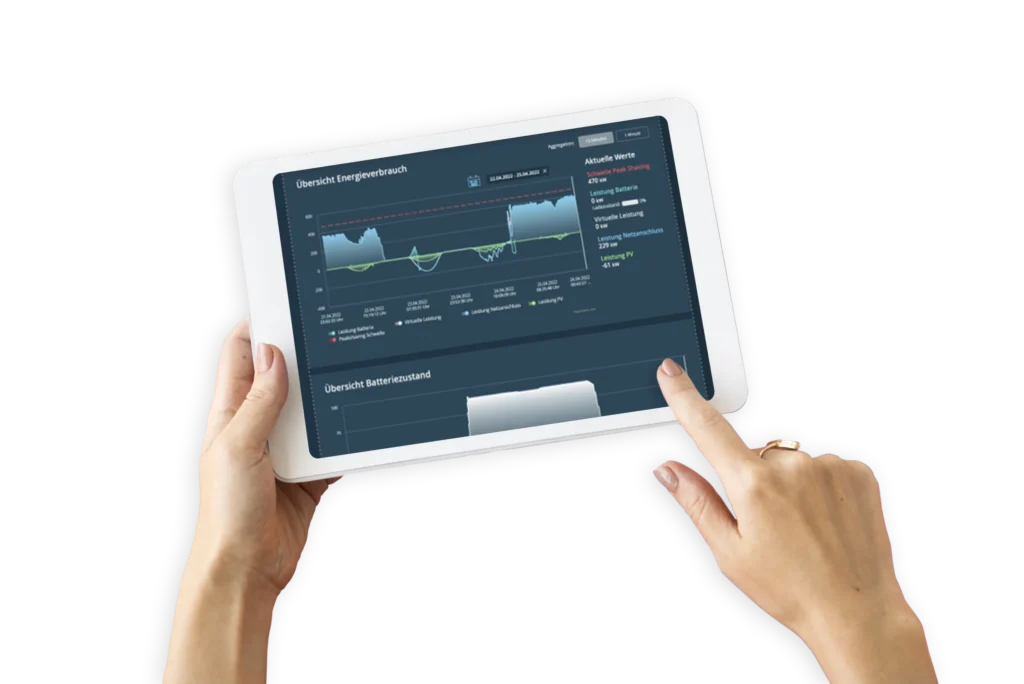
Grid-oriented control is typically carried out via a smart metering system with a control unit or a suitable control box installed by the grid operator. The transmitted control signals can also be received and processed by an energy management system (EMS), which coordinates the necessary power adjustments of the controllable consumption devices within the customer’s facility.
Why is Section 14a of the Energy Industry Act (EnWG) relevant for charging infrastructure operators (CPOs)?
For charging infrastructure operators (CPOs) of smaller, non-public charging points—such as those located in employee parking lots or residential complexes—Section 14a of the Energy Industry Act (EnWG) serves as the governing legal framework for grid connection and grid fee reductions. Operators benefit from the fact that grid connection may generally no longer be denied due to potential grid bottlenecks, provided that the controllability requirements are met. Larger, public charging parks connected to the medium-voltage grid, on the other hand, generally do not fall under this regulation but are subject to the requirements of VDE-AR-N 4110 and the remote control signal regime specified therein.
Definition: Section 14a of the Energy Industry Act (EnWG), remote control signals, and dynamic charging management
Not to be confused with:
- Remote control signals: the technical equivalent for larger facilities connected to the medium-voltage grid, legally based on VDE-AR-N 4110 rather than Section 14a of the Energy Act (EnWG)
- Dynamic Charging Management: Operational optimization of charging capacity by the operator itself, independent of grid-side control interventions pursuant to Section 14a of the Energy Industry Act (EnWG)
- Grid Fees and Surcharges: Section 14a of the Energy Industry Act (EnWG) allows for reduced grid fees for certain controllable consumption facilities, but does not apply to surcharges
Conclusion: What does Section 14a of the Energy Industry Act (EnWG) mean for non-public charging stations?
Section 14a of the Energy Industry Act (EnWG) establishes, effective in 2024, a uniform nationwide framework for the connection and operation of smaller controllable consumption facilities, such as non-public charging points. Operators benefit from a generally guaranteed grid connection and potentially reduced grid fees; in return, however, they must ensure that their systems are technically controllable. For larger charging parks connected to the medium-voltage grid, the telecontrol connection in accordance with VDE-AR-N 4110 remains relevant.
Note: This article is intended for general informational purposes only and is not a substitute for individual legal, technical, or financial advice.